How Victoria Falls Was Formed: The Geology Explained
The fascinating geology of Victoria Falls: how millions of years of volcanic basalt, cracks and river erosion created the falls and its famous zigzag gorges.
How Victoria Falls Was Formed: The Geology Explained
Stand at the edge of Victoria Falls and you are looking at the result of millions of years of geology playing out in slow motion. The falls are not just beautiful, they are a textbook example of how rivers, rock and time work together. Understanding how the falls formed makes a visit far richer, because you start to read the landscape and see the story written into the gorges. Here is the geology, explained in plain language.
Key takeaways:
- Victoria Falls sits on a vast sheet of basalt, volcanic rock that cooled and cracked millions of years ago.
- The Zambezi erodes along these cracks, so the falls slowly retreat upstream over time.
- The famous zigzag gorges downstream are former positions of the falls, each an old waterfall line.
- The falls are up to 108 metres high and over 1,700 metres wide, making them the largest sheet of falling water on earth.
The basalt foundation
The whole story starts with basalt. Around 180 million years ago, enormous volumes of lava spread across this part of southern Africa and cooled into a thick, hard layer of basalt rock. As it cooled it cracked, forming a grid of fractures and joints, some running roughly east to west and others north to south. Those cracks are the key to everything that follows.
On top of the basalt, softer sediments later filled some of the fractures. Softer material erodes faster than the hard basalt around it, and that difference is what the river exploits.
How the river makes a waterfall
The Zambezi flows across the flat basalt sheet and reaches a line where the rock drops away. Water pours over this edge into a deep, narrow chasm. The falls today plunge into a gorge that is only about the width of the river itself, which is unusual and part of what makes Victoria Falls so dramatic. Instead of a broad plunge pool, the entire river funnels into a single narrow slot and then escapes through a gap into the gorge system beyond.
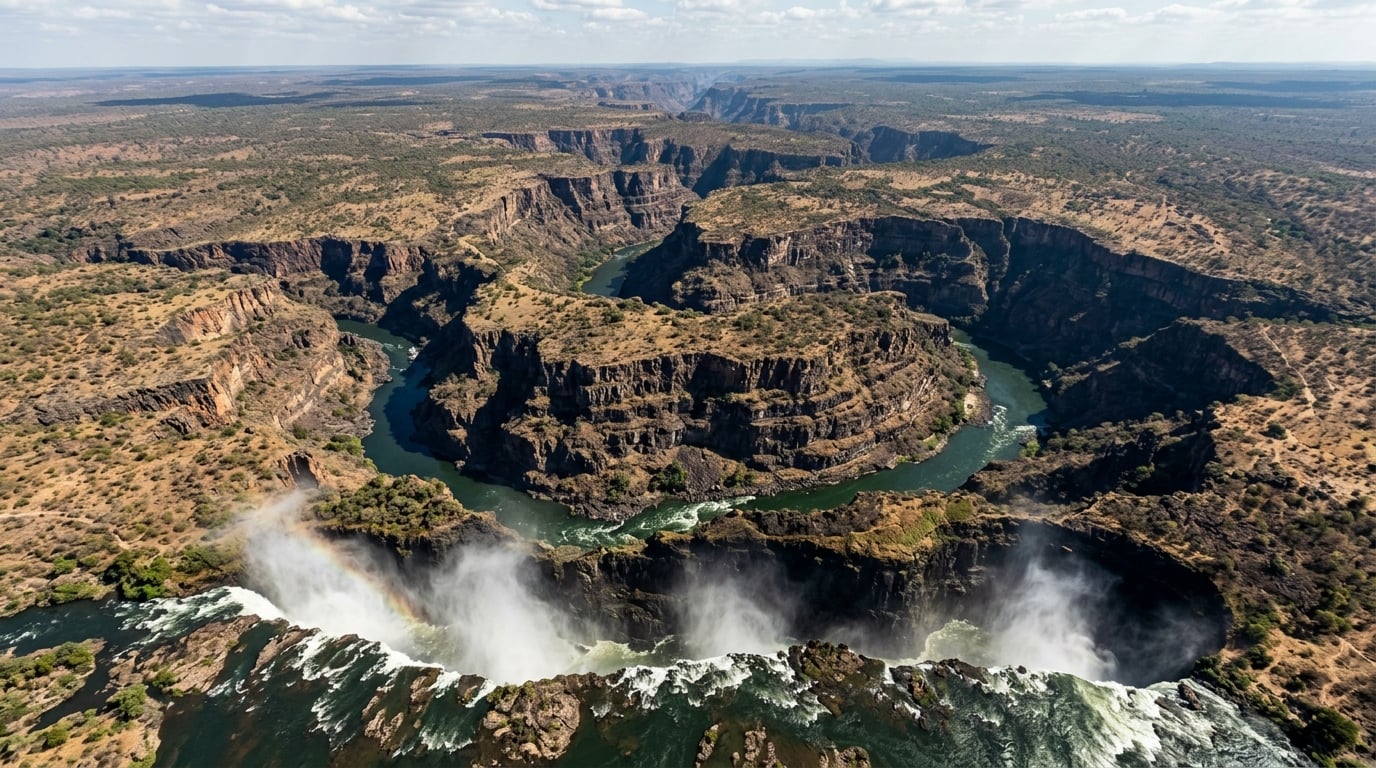
From above, on a helicopter flight, the geometry becomes obvious. You can see the wide curtain of water dropping into a tight zigzag canyon, and it looks almost engineered.
The retreating falls and the zigzag gorges
Here is the fascinating part. The falls have not always been where they are now. Over hundreds of thousands of years, the river has cut back along one crack, then another, then another. Each time it wore through a soft-filled fracture, it created a new waterfall line and abandoned the old one.
The result is the series of sharp zigzag gorges you see downstream, the same ones the white water rafting runs through. Each gorge is a fossil waterfall, a place where Victoria Falls once stood before the river moved on. Geologists have counted at least eight former positions. The falls are, in effect, slowly marching upstream, and the current position is simply the latest chapter.
The scale of the falls
The numbers are staggering. The falls stretch more than 1,700 metres across and drop as much as 108 metres into the gorge. At peak flow in the wet season, an immense volume of water pours over every minute, throwing up the spray cloud that gives the falls their local name, Mosi-oa-Tunya, the smoke that thunders, visible from far away. This combination of great height and great width is why Victoria Falls is considered the largest single sheet of falling water in the world, a point our comparison of the world's great falls touches on.
Reading the landscape on your visit
Once you know the geology, the falls come alive:
- Look for the Devils Cataract at the western end, where the river is actively cutting back and beginning to form the next gorge.
- Notice how the falls face a sheer wall just across the chasm, which is the far side of the same crack the river is exploiting.
- From the bridge or a viewpoint, trace the zigzag gorges downstream and picture the falls once standing at each bend.
- On the water, a canoe trip on the calm upper river shows you the flat basalt plain before the drop.
The bottom line
Victoria Falls is a living geology lesson. A sheet of ancient basalt, a grid of cracks, a powerful river and vast amounts of time have combined to create one of the planet's great natural wonders, and the process is still going on. Knowing the story turns a great view into something you can actually read in the rock. To make the most of your visit, pair this with our complete travel guide and see it all from above on a scenic flight.
Ready to Experience Victoria Falls?
Explore our curated selection of activities and start planning your unforgettable adventure today.